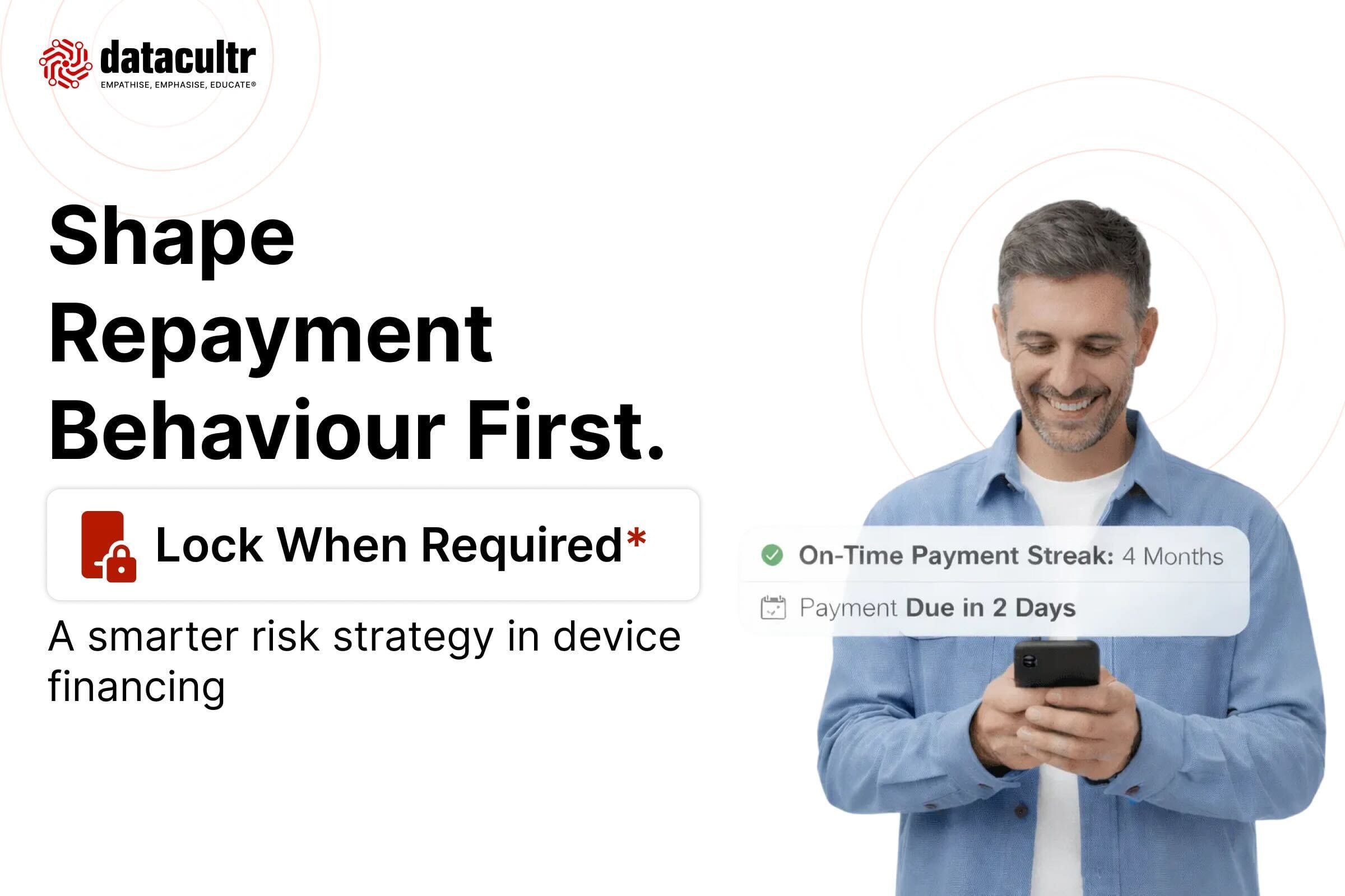
In device financing, device lock is often seen as the primary risk control tool.
Missed payment? Lock the device.
Payment resumes? Unlock it.
This model has enabled lenders to confidently extend credit to new-to-credit and thin-file customers while protecting the financed asset.
But customer expectations are evolving. Borrowers today expect clarity, timely reminders, and fair, empathetic communication, not just enforcement after a miss. As device financing scales and ticket sizes rise, relying only on control mechanisms is no longer enough.
In 2026, the key difference between average and high-performing device financing portfolios will be the ability to shape repayment behaviour early, through consistent, device-led engagement that prevents delays before they turn into defaults, while keeping device lock as a structured backstop.
Why Repayment Behaviour is the Real Risk Lever
Defaults in device financing rarely happen all at once. They build gradually, through missed reminders, confusion around dues, broken communication, or small delays that slowly become a habit. Common patterns include:
When these patterns repeat, portfolios reflect it quickly through rising DPD movement and weaker roll rates. Early-stage slippage is often the clearest signal of future delinquency.
The environment is also becoming more demanding. In India, industry executives have indicated mobile financing default rates in the ~2.7%–2.9% range (vs ~2% expected), showing how quickly risk can rise as ticket sizes increase and device prices move up. This reinforces why managing repayment behaviour early is critical for long-term portfolio health.
The Behaviour Stack that Improves Repayment Outcomes
1. Set clear repayment expectations from the start
Most repayment issues begin with uncertainty, not unwillingness. When customers are unclear about when to pay, how often to pay, or what happens if they delay, even willing payers can slip. Clear expectations remove this ambiguity early.
Make sure the customer understands:
- Exact due dates and payment frequency
- The total amount to be repaid over the loan period
- Consequences of missed payments, explained simply and upfront
This reduces disputes, confusion, and the “I didn’t know” delays that damage repayment behaviour.
2. Consistent, device-linked communication
In device financing, the phone itself is the strongest engagement channel. Direct-to-device reminders, lock-screen alerts, and in-app notifications outperform generic SMS or IVR because:
- They reach the customer on the financed device
- They are harder to ignore
- They feel contextual, not intrusive
This keeps repayment top-of-mind without escalating pressure, improving early-stage collections efficiency. The goal is not message volume, it is visibility and timing.
3. Behaviour-based segmentation
Not all delays mean the same thing. Some customers pay late once and self-correct. Others miss repeatedly and disengage. Treating both as the same increases cost and weakens outcomes.
This is why advanced risk management teams segment customers using behavioural signals such as:
- Payment history and consistency
- Response behaviour to reminders
- Reliability of promise-to-pay commitments
4. Disciplined use of device lock
Device lock works best when customers clearly understand why it is happening and how to resolve it. Instead of feeling sudden or confusing, its use should follow a visible sequence:
- Customers are informed in advance that continued non-payment can lead to restrictions
- Reminders clearly state what action is required to avoid locking
- Once payment is made, access is restored
Where Datacultr Fits: Behaviour-Led Risk Management
Datacultr’s approach to device financing risk management is built around one principle: shape repayment behaviour first, enforce only when required. The platform uses the financed device as the primary engagement channel, helping lenders stay visible and connected throughout the repayment journey, before delays turn into defaults.
Alongside device lock as a strong asset-level control, Datacultr enables behaviour-led engagement across key stages:
Pre-due stage:
- Flash Messages with smart CTAs: On-screen reminders with clear calls to action. Result: 25% increase in on-time payments.
- DigiCall: Secure, authenticated, bank-branded digital calling that reaches the device, not just a phone number. 100% Safe, 100% Actionable.
Early collection stage:
- Wallpaper Reminder: Always-visible payment reminders without restricting device usage. Result: 72% of payments received within 48 hours.
- Promise to Pay: Capture customer intent to repay later and guide next actions. Result: 67% reduction in NPLs.
Late collection stage:
- Mobile Number on Demand (MOD): Instant access to the customer’s active phone number on the device. Result: 4× higher recoveries.
- Location on Demand (LOD): Real-time, intelligent location insights, designed to strengthen risk models and improve collections workflows. Result: 30% higher collection success.
Together, these engagement-led actions have delivered clear results across device financing portfolios:
25%
4x
67%
This is why, in 2026, the strongest device financing portfolios will be defined not by how quickly they enforce device lock, but by how effectively they influence repayment behaviour before enforcement is needed.
People Also Ask
Is device lock enough to manage risk in device financing?
Device lock is an important risk management tool in device financing, but it is not sufficient on its own. Managing repayment behaviour early through device-led engagement helps prevent delays before enforcement is required. Platforms like Datacultr enable this by combining device lock with continuous device-level communication, allowing lenders to influence repayment behaviour before enforcement becomes necessary.
How do lenders improve repayment behaviour in device financing?
Lenders can improve repayment behaviour in device financing by setting clear payment expectations, using device-based communication, and segmenting customers based on behavioural signals. Datacultr supports this by using the financed device as the primary engagement channel, enabling reminders, promise-to-pay workflows, and structured escalation to reduce slippages and improve repayment outcomes.
Does customer engagement reduce defaults in device financing?
Yes, customer engagement reduces defaults in device financing by improving on-time payments, lowering early-stage delinquency, and increasing post-due recoveries, especially when communication happens on the financed device. Datacultr’s device-led engagement model ensures messages are visible, contextual, and actionable, helping lenders influence repayment behaviour before small delays turn into chronic defaults and non-performing loans.
How does Datacultr manage risk in device financing beyond device lock?
Datacultr manages risk in device financing by focusing on the full repayment journey and shaping repayment behaviour through device-level engagement, using device lock as a structured enforcement tool rather than a first response. Beyond device lock, Datacultr enables disciplined pre-due engagement, early collections, and late-stage recovery, allowing lenders to intervene early, escalate transparently, and improve repayment consistency across device financing portfolios.