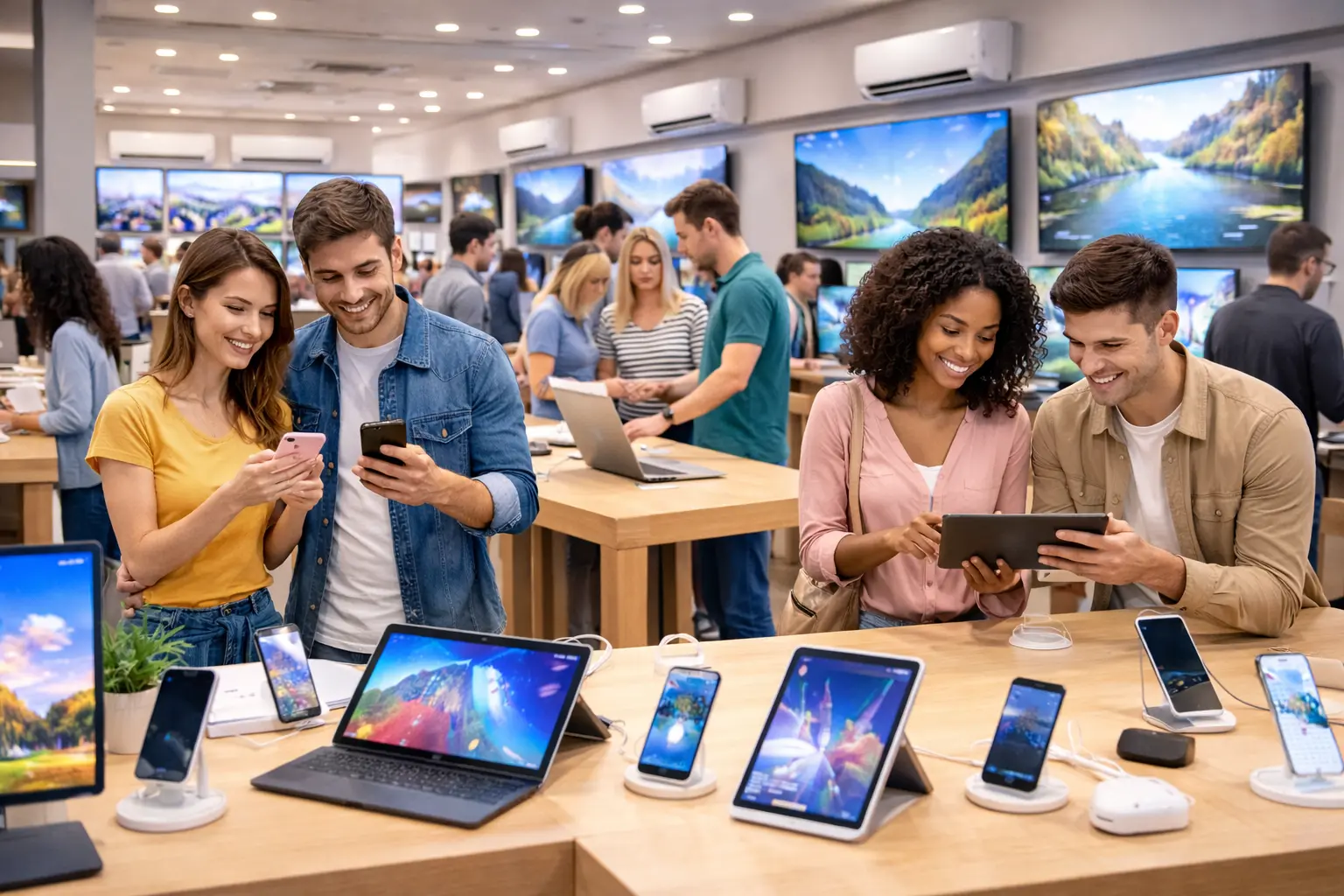
For years, banks and lenders have played a central role in financial inclusion, and that does not change.
In fact, the next wave of inclusion will depend on them even more, as consumer needs evolve beyond traditional credit into everyday essential devices.
What has become clear through the last few years is this:
Smartphone financing works consistently when driven via a strong risk management strategy and device locking platform, at scale, and it has opened the door for financing an entirely new category of devices and consumer durables, even appliances.
Datacultr has already helped power over 25 million financed smartphones; for most, it was their first loan.
That success has created clarity for the industry:
👉 If financing a smartphone helps customers access connectivity, work, identity, and opportunity.
👉 Then, financing TVs, laptops, ACs, refrigerators, and other appliances will unlock the next chapter of household inclusion.
And that is the real outlook for 2026.
Why Customers Want These Devices on Finance
Across emerging markets, households are upgrading, not just their phones, but their lifestyles.
People want better devices, but affordability remains a barrier.
Consumers want to upgrade because these devices help:
- Students access educational content (TV, laptop)
- Support gig work or remote work (laptop)
- Improve home efficiency and comfort (ACs, refrigerators)
- Stay connected, informed, and entertained (TVs, smart devices)
The need is clear, and banks and NBFCs are going to play a crucial role
Why Device Financing Is a Major Opportunity for Banks & Lenders
Smartphone financing has proven 3 important truths:
- Customers repay when the device is important to them – Smartphones showed extremely strong repayment behaviour because the device is essential to daily life.
- The first loan creates the trust loop – Among first-time smartphone borrowers, 40% return for a second loan, proving the good risk quality of this segment.
- Device financing grows the lending pie – Banks can acquire new customers, build long-term relationships, and expand into households that traditional credit models don’t reach.
This success is exactly why lenders are now exploring TVs, laptops, ACs, and appliances:
👉 High-demand devices + flexible financing = massive inclusion and revenue potential.
👉 Banks get access to new, credit-thin customers, but with a secured asset (the device).
👉 Customers get access to devices they otherwise couldn’t afford.
A win–win system, already validated through smartphones.
The Challenge: Scaling Device Financing Beyond Phones
And what Datacultr has already solved.
When financing expands into larger, more diverse device categories, lenders face new questions:
- How do we secure devices that aren’t always online (TVs, appliances)?
- How do we manage risk when customers have no credit history?
- How do we ensure repayments are consistent across large portfolios?
- How do we handle communication, follow-ups, compliance, and legal steps across millions of devices?
These are not theoretical problems.
Lenders encountered them during smartphone financing, and Datacultr solved them.
Now, those same foundations are ready to support TVs, laptops, ACs, appliances, and beyond.
Datacultr in 2026: The Platform Built for Multi-Device Financing
Based on the proven success of smartphones, Datacultr now powers end-to-end financing across device categories through three core pillars:
1. Device-Level Security for Every Category
We tailor security models based on the device’s characteristics:
Offline lock
SIM/network restriction where applicable
Tamper/bypass protection
On-device communication
IoT locks for non-smart appliances
Smartphones, TVs, laptops, and appliances each behave differently —
Datacultr adapts risk control to each one.
2. Intelligent, Automated Collections for All Devices
Datacultr’s suite now works across device categories:
DigiCalls for instant automated follow-ups
PTP journeys to convert intent into payment
Digital Legal Notices for compliance
On-device reminders and nudges (including non-phone devices)
This ensures lenders manage collections for any device, any market, any bucket: digitally, ethically, and at scale.
For smartphones, the undeletable Odyssey app is used for managing the entire lifecycle. For other devices, Datacultr’s smart SDK on the end-user app allows the financier to manage end-to-end.
3. Behaviour-Led Borrower Engagement (TrueDigi)
The intelligence layer that:
Learns borrower repayment patterns
Anticipates delinquency
Triggers the right intervention at the right time
Improves repayment rates across all device types
2026 Outlook: The Shift from One Device to the Whole Household
Because smartphone financing worked, 2026 will see:
✔️ TV financing become mainstream
✔️ Laptops financed for education and work
✔️ ACs and appliances financed as homes upgrade
✔️ Banks expanding into device-led credit for new customers
✔️ OEMs and retailers adopting finance-first distribution models
✔️ Telcos bundling multiple devices into financed packages
✔️ New business models like device subscription and renting have also become viable
The household is becoming the centre of financial inclusion, and every key device in that home can now be financed responsibly.
Conclusion: Datacultr Has Already Built the Path; Now the Market Is Expanding It
Banks and lenders remain at the heart of this shift.
Customers continue to demand better devices.
OEMs and retailers are ready to scale financing.
And Datacultr provides the rails that connect them securely, ethically, and with proven success across 25 million devices.
2026 isn’t a prediction.
It’s the next step of a model that has already proven itself.
From smartphones to the entire household, financed devices will drive the next wave of inclusion, and Datacultr will power it.
People Also Ask
Why is multi-device financing the next logical step after smartphones?
Smartphone financing proved that people repay when the device is important to their daily life. The same is now true for TVs, laptops, ACs, and appliances. These devices support education, work, and basic household needs. Once smartphones worked at scale, financing more devices is a natural next step
How can lenders serve first-time borrowers across multiple devices?
Smartphone financing showed that first-time borrowers can be trusted when the product has real value. Many of them return for a second loan. Multi-device financing builds on this. Lenders start with one essential device and gradually finance more devices within the same household, growing the relationship without increasing risk.
What makes Datacultr suitable for financing multiple devices?
Datacultr was built to manage risk, engagement, and collections at the device level, not just at the loan level. This means the same system that works for smartphones can also secure and manage TVs, laptops, and appliances, even when they are offline. Lenders can use one platform to manage repayments, communication, and compliance across all device types.